VISUAL AUTHORITY ASSESSMENT: Meridith Grundei
Here's everything we covered on our call, translated into the visual library that carries you through the next year and beyond.
YOUR VISION
Let me start with what I see.
You’ve lived your life in theaters. You know presence in your soul, the way only someone who has actually done it can, and that’s exactly why you can build it in other people. In a field crowded with nine thousand coaches selling polish and BS tips and tricks, you’re the one telling people to stop performing and sound like themselves. That, right there, is the whole game, and you’re already winning it with your voice. The only piece that has not caught up to you yet is the visual one.
So let's fix that.
You have three primary offers in the shop front window right now, and they pull in three different directions. That is the picture this library gets built around.
The first is the Amazon play. You built a program for the New Voices community inside AWS, the builders, the partners, the evangelists, global and virtual, three cohorts of five workshops each, all of it running on the Ready Room and laced with improv to get people uncomfortable on purpose. You’ve been delivering it for three years. The move now is to take that case study and shop it to other companies. That makes the visual proof of how you actually deliver that program the most valuable thing to capture, because you shoot it once and you sell it into every corporate pitch you make for the next two years.
The second is the VIP day. Full day, nine to five, one on one, in person or virtual or hybrid, getting someone ready for the highest stakes moment they have, a stage or a pitch. Since it’s a high-ticket piece, it needs visuals that let a buyer feel what a day in the room with you is actually like.
The third is the retreat. Unscripted, this October, fifteen seats, about five left to fill. You already have the setup most coaches would kill for, the boardroom, the fake stage, the multiple scenarios. That room is the single best place to capture everything you are, all in one weekend.
Now here is the part that ties it together, and it is the part that matters most.
When I asked who you serve, you said a wide range of humans, industry agnostic. Fair. But that is not who this is for. Underneath every one of those rooms is one specific person.
The expert who is scared of being packaged into someone polished and fake, who wants to get on a stage and still sound like themselves. Tech execs, creatives who leverage a stage, entrepreneurs, the food stylist with the cookbook and the book tour, they all share that one fear. You’re the person who tells them they do not have to forget who they are to be good up there. You help them bring their own genius instead of performing what they think the audience wants. That is the secret sauce and it is the thing the other nine thousand speaking coaches cannot copy.
So the visuals cannot be polished for the sake of looking professional. The LinkedIn selfies, the curse words in your posts, the woman who corrects you mid-talk and gets a genuine thank you instead of a defensive coach, all of that is the brand. The visual library extends it.
Your images have to carry both of you at once. The person who has lived and breathed her life in a theater and knows exactly how to build presence in a room, and the unfiltered, feisty, perfectly imperfect human who would rather flub a word and laugh about it than fake her way through. That tension is not something to fix. It is your whole thing. Everything below is built to capture it.
THE VISUAL AUTHORITY Library

Think of your visual content as a library that works for you around the clock, building connection and trust and shortening your sales cycle while you are nowhere near the room.
When your images show the full picture, your expertise, your process, your personality, and the small slice-of-life details that make you human, people get pulled into your world and they trust you faster. They say yes faster. That’s Decision Velocity, and it is the entire point of the spend. The photos do not book the business. They earn you the right to the conversation when the fit is right. Your IP, your track record, and how you show up in the actual sales conversation earn the sale.
(For visual references to the types of photos discussed below, refer back to the slide deck and the recording of our call.)
The library breaks into three categories. Here's how each one translates for you specifically.
CORE ASSETS
What they are:
Your headshots, wider portraits, and vertical portraits. The looking-directly-into-camera images that answer the question "Who the hell is this person?" They live everywhere: website, speaker and media kit, one-sheets, social profiles, slides, PDFs, bureau pages.
Your wardrobe is something to marinate on ASAP:
I am saying it plainly because it halts everything else. You do not have a stage uniform, but you did mention the blouse and slacks, the dress, the Doc Martens, you tried the heels, and none of them feel like you yet. Good. That means you’re giving it a think. But the branding session, as a whole, needs to wait until you land it, because the entire job of these images falls down a flight of stairs if you’re wearing a version of yourself you do not want to share.
So here is a starting point to help move this process along. Pick the two outfits you have felt most like yourself in on a stage, and build from there. Use the Doc Martens, because that is already you and it reads (and it’s quite a popular choice for keynoters). Once you have those two, identify another 12-15 looks for the branding session based on swapping the top, adding or dropping a layer, and changing the pants. The rest of the visual variety and emotion comes from expression, composition, and location, not from outfit changes.
In terms of the non-Core Asset photos for your branding session, wear what you wear. I know you do the T-Shirt and sweat pants, and that’s fine if you’re comfortable in them - it does tie exactly back to your perfection imperfection vibe, but just one thing: don’t throw on the stuff with the holes and stains in it. I’m pretty sure I didn’t have to mention that, but, you know, had to say it.
The job of these images is to make the fee make sense.
You want VIP days that command real money and corporate contracts that pay like corporate contracts. Nobody signs that off an accidental smartphone headshot or, God forbid, the old actor headshot an outlet dug up and ran without asking. Your Core Assets walk into the room before you do and signal she knows her shit and is the kind of person I want in front of my people. Credible and fun at the same time, which is exactly the constellation you gave me.
Location strategy:
Your entire session happens in a modern, sophisticated co-working space, and that is deliberate. Not your apartment. Not the corner of your bedroom with the bed in the frame. The space itself has to operate at the level you charge at, clean lines, glass, contemporary textures that fall out of focus behind you. That out-of-focus backdrop is not decoration. It builds the gravitas that matches the level you operate at, and it carries the current, corporate-credible read that a real chunk of your work demands.
Pick a space with a few different areas to work, a lounge corner, a glass-walled room, a window with good light, a long table. Having multiple areas inside one building is how a single session produces a deep, fresh-looking set of assets for your website, speaker and media kit, and social profiles, instead of the same wall over and over. Whatever sophisticated co-working space you can get access to with that kind of variety wins, and the right photographer turns it into a full library. I can suggest the space I use on repeat, if you’d like.
The expressions to capture:
These come straight from your mouth, and they carry equal weight. How you want to be seen by the people you serve: credible, fun, creative, passionate, and feisty. The personality you want coming through: intuitive, loyal, caring, genuine, and unfiltered. Genuine, not authentic, because you are right, authentic is overused and everybody hides behind it.
You’re an actress, so getting these into your eyes and your body is the easy part. The photographer reads the words back to you and you react. The only real risk is overshooting it into caricature, so the direction is restraint. You’re not a dancing monkey over here. You’re a feisty, genuine expert who happens to be having a real conversation with the lens. That’s the whole ballgame with Core Assets.
VISUAL EVIDENCE
What it is:
You caught in the act of doing the work, solo and client-facing. It answers "Is she actually doing this, and is she who she says she is?" and it is the biggest sales-cycle shortener you have, because it lets people see what it’s like to work with you instead of taking your word for it.
This is also the category with the most ground to gain, because almost everything you have captured so far has been accidental, whatever a participant tagged you in or an event photographer happened to grab. Now it gets built on purpose, as part of a system that keeps evolving.
Location strategy:
Same place, same logic. The professional Visual Evidence, the recreated solo work, the virtual delivery, the VIP intake, all of it gets staged in the co-working space, because that is where you can match the room to the moment. A conference room or boardroom that reads real for the workshops. A clean, modern space for the virtual delivery. The job is to make the recreated shots land as convincingly as the live ones.
Your home finally gets its role here, and it is the right one. It is the location for the smartphone shots you grab yourself, the messy desk before a presentation, the laptop open with the work on it, the day-to-day texture. Home is the phone-camera location, not the professional one. The live rooms, the retreat and the events, get captured where they actually happen.
Shoot for flexibility:
Every scenario below gets shot wide, medium, and close, from the left, the right, and head-on. Same moment, multiple angles and compositions. This is what lets a single session produce a website banner, a vertical reel cover, a square carousel slide, a wide header, and a pile of social content with no reshoot. Never treat a delivered image as locked to its original crop. Cut it, crop it, repurpose it. The more variety captured in the room, the more marketing problems these images solve later.
Solo work
The thing that makes you different is that you’re not theorizing from a slide, you are in the work. So that is exactly what gets shot. You on the laptop mid-thought, the headset on while a podcast or audiobook runs, the notebook, the pen, and the envelope you actually write your ideas on the back of. Lean into that envelope. Pick up a few that read like the bills you scribble on and use them in the session, because that detail is true to you and nobody else has it. Notion, your journal, the messy all-over-the-place process you described, all of it is fair game, because showing how the sausage gets made is the proof.
If you brainstorm in more than one way, pen to paper one minute and Notion the next, grab both, so the images show the range of how you actually iterate. And, be sure to move from location to another, in another casual outfit for each scenario to create more visual variety in the session.
Speaking
Here’s something we didn’t touch on during the call. You do not have to wait for a live event to get speaking shots. During the branding session, have your photographer find a plain wall, you’re wearing a client-facing outfit, your audience is the lens, and you deliver your keynote. Preferably, deliver a piece that has some ups and downs emotionally in it so that you’re expressing different emotions through your face and body language. (Below are some examples)
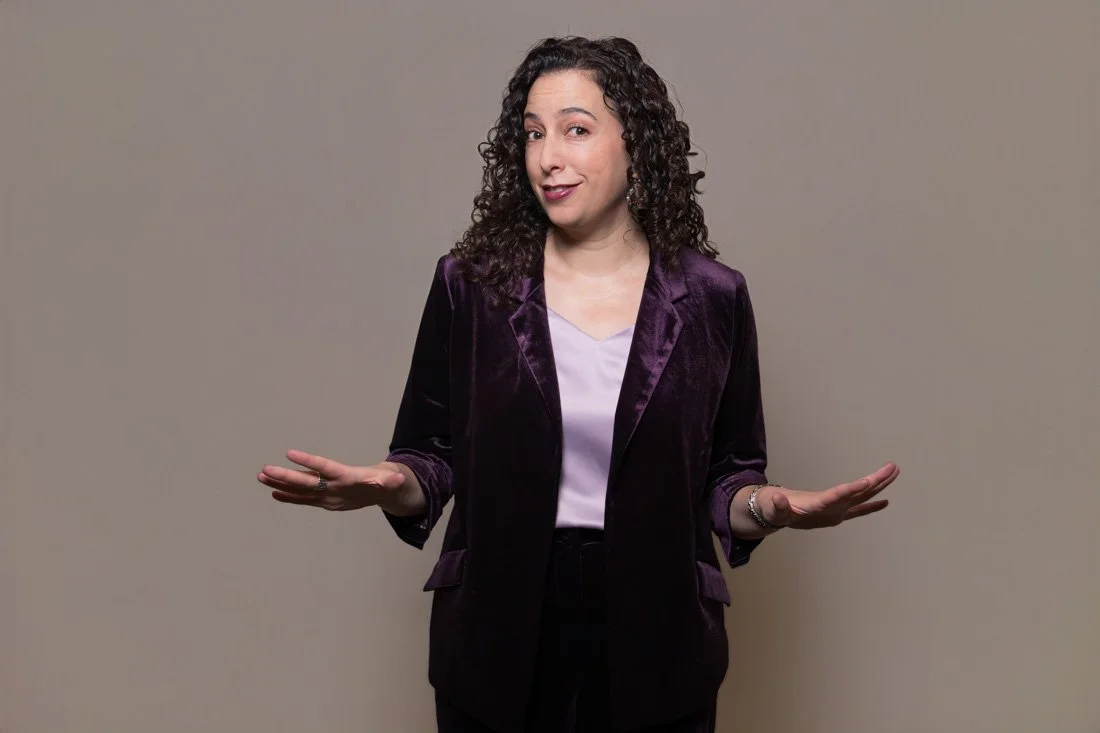
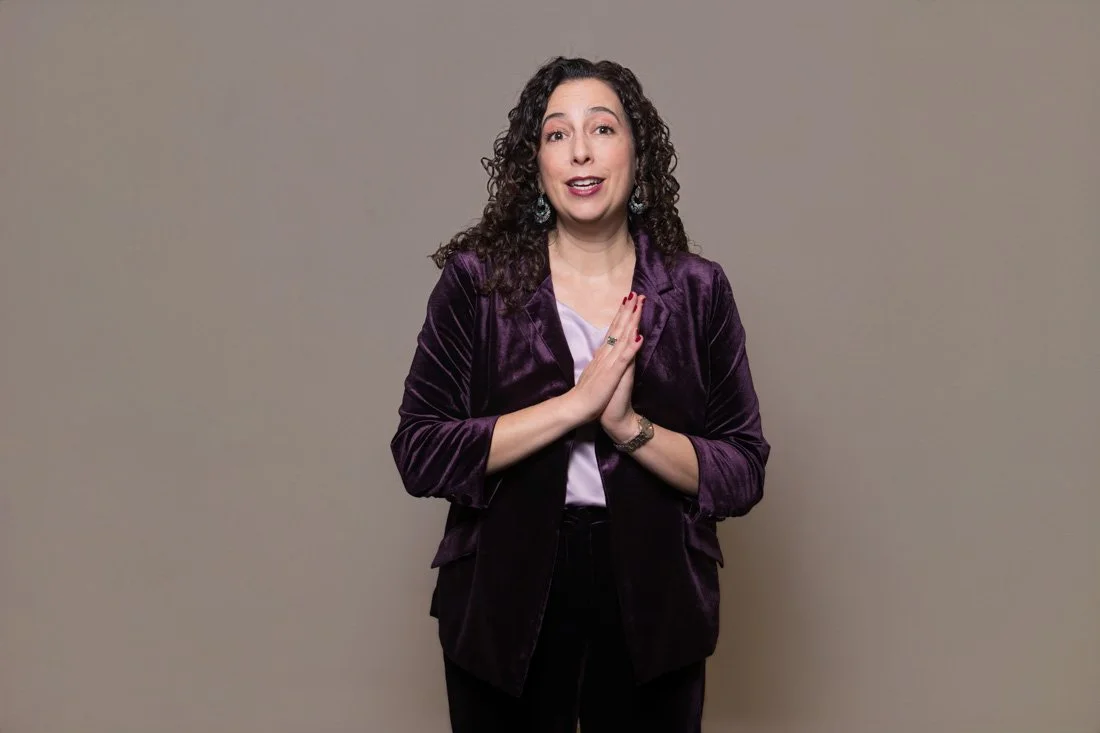
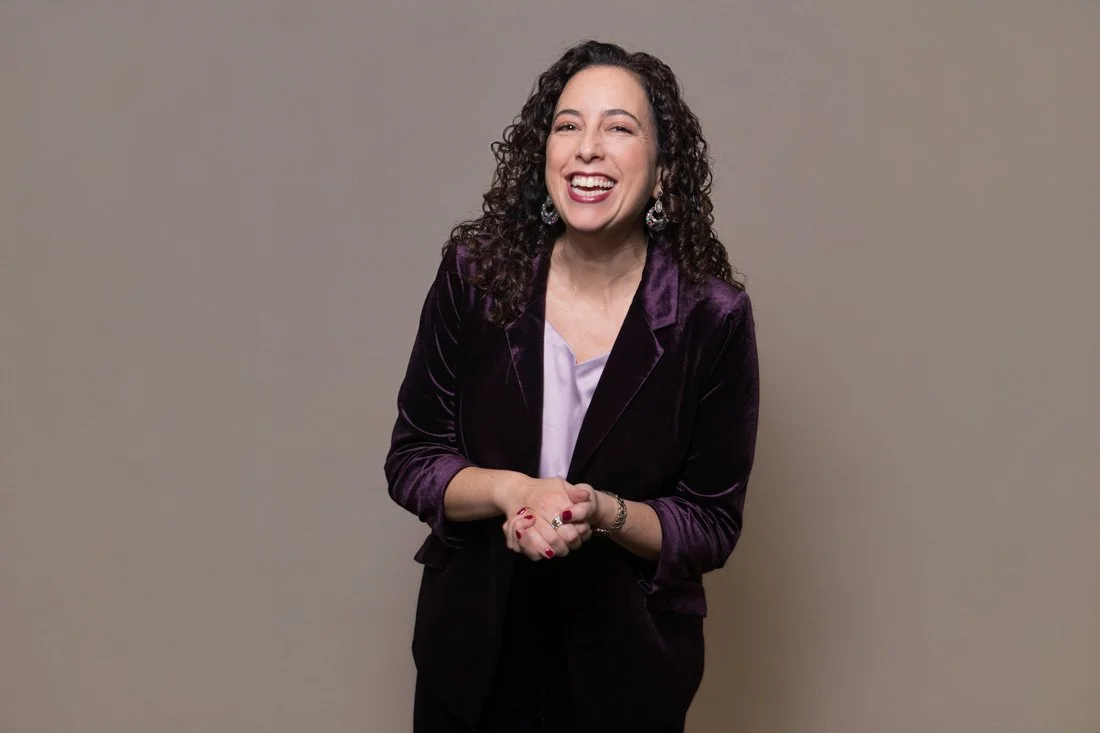
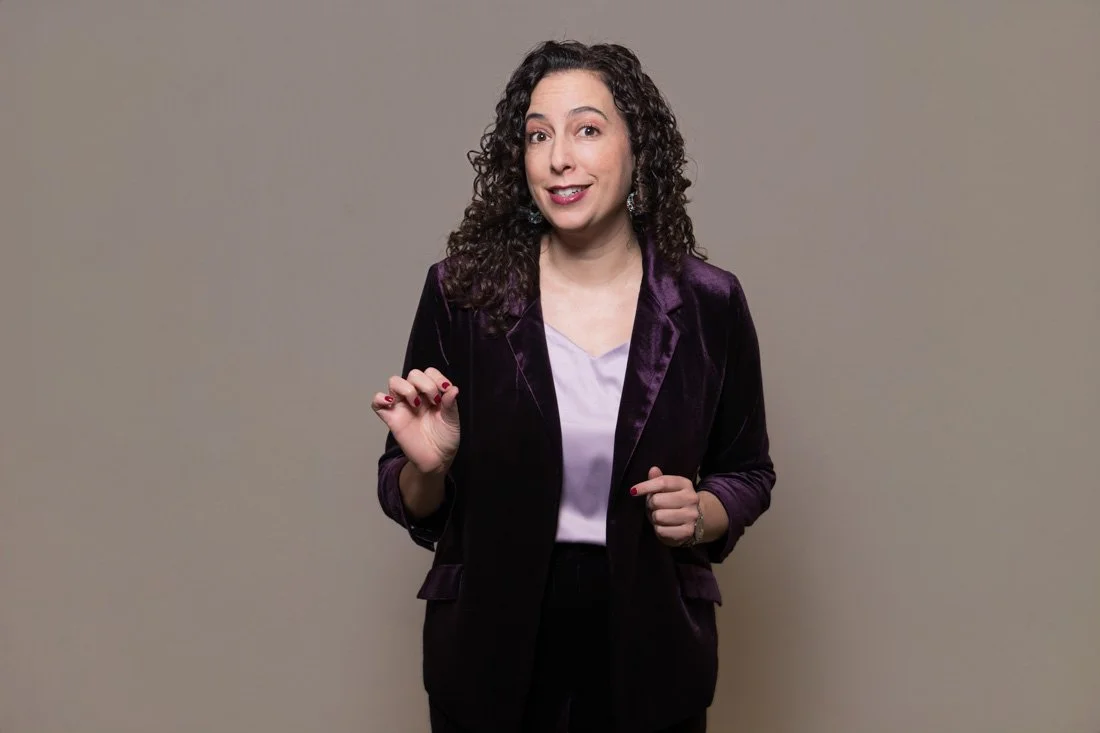
These images are ideal for either adding text and branding to the negative space as-is, or cutting you out of the background and adding you to another marketing asset.
This works because of who you are. You cannot stand up and teach without your energy and emotion pouring out of you, and that’s the entire asset. The context, the exact words, the framework you’re walking through, none of that has to be legible. What has to land is you, lit up, doing the thing. This is where the theater shows up without you saying a word about it.
Client-facing work: the three main offers
This is where the shop front window items each get their own treatment, because each one has a different job.
The Amazon-style corporate delivery. This is the highest-leverage capture you have, because it is the proof you pitch the next company with. You shoot it once and it sells for you again and again.
For the virtual delivery, recreate it during the branding session in the co-working space: you talking to the screen with your arms going, a real conversation with the group, the Ready Room model on a slide next to you with your logo so it stays evergreen. Once your photographer captures a series of virtual images, then have him capture the behind-the-scenes of the same activity, with your envelope, notebook and phone next to the computer.
For in-person delivery, shoot in a conference room with an option for slides, whiteboard and space for flip chart paper. You’re writing on the board and paper, as well as delivering your presentation. Show the tools of the trade, including the handout next to the laptop. As we discussed, have a laptop on the table in front of you, and make sure the photographer captures you in a way that fills the frame and minimizes the fact that there’s no one in the room but you.
The VIP day. Your margin work, captured in person and virtually, getting one expert ready for a high-stakes stage or pitch.
For the virtual capture, your full-screen speaker mode virtual images for the corporate delivery do double duty here. It’ll look the same, so the setup can be the same. Just change your top so you have some visual variety to work with for your marketing assets.
For the in-person capture, bring in a colleague as a body prop, never revealing their face, but recreating what this session looks like - you leaning in, listening, taking notes, practicing with them, the caring and intuitive body language of someone who is with the client, not talking over them.
The retreat and your own events. This is the goldmine, and it is the nearest deadline. Unscripted gives you the boardroom and the fake stage in one place, which is where your theater and your improv are most visible, so capture the before, the during, and the after. Last year you felt the participant assets came out fine but not intentional. Fix that this time. Tell the photographer to treat the room as real, set the table so the boardroom reads like a boardroom, shoot through the people, and capture your fifteen participants presenting so they walk away with assets too. That move makes you the superstar who does not just teach them to be better, you hand them the proof. For the Chicago event, shoot the room setup, because that material becomes content promoting the next one.
Professional and smartphone photos:
Professional:
The foundational layer gets captured in one efficient sweep at the branding session: the solo working shots, the speaking to camera captures, the recreated corporate delivery, the recreated VIP intake, the brainstorming, the Ready Room handout and model. Then the live rooms across the year, the retreat and the keynotes, get shot start to finish, because the live capture is what proves you are in demand and keeps the library current. Also, the audience is an important part of your library. Engaging each other, asking questions, taking notes - all of that is money. Aim for two or three of these a year so the variety keeps building.
Smartphone:
This is where your phone earns its keep, and you are already most of the way there. Your LinkedIn is wall-to-wall selfies in random places, and that instinct is right. Now level it up. Get it out of your hand, prop it against a table, set a ten-second timer, and catch yourself reading, thinking, working, not staring at the lens. Build recurring staples the way I shoot before every flight, you on the plane getting work done, the messy desk before a presentation, the screen grab turned into a real photo by stepping behind the laptop and shooting it with you in frame. And keep inspiring your participants to photograph you and tag you, because those shots can look like a dumpster fire of biblical proportions… and yet, it does not matter. What matters is somebody was moved enough to take one.
Why it matters:
Visual Evidence shortens your sales cycle. When a buyer can see your energy, preparation, and the room reacting to you, they connect and trust faster, and you stop spending the first half of every call proving you belong. It also hands you a deep well of stories to tell through images instead of just words.
MISSING DETAILS
What it is:
The professional signals and personal touches that answer "What makes her different?" The signals establish authority. The personal touches make you human. Together they paint the full picture, and they are the part most experts have no idea they are missing.
Professional signals:
You said nothing jumped to mind when I asked, and honestly that makes sense based on who you are. You are not a trophy-on-the-shelf bragger, and forcing that would break the brand. But you have more proof than you are giving yourself credit for, and almost none of it is working for you visually yet:
The three-year, global Amazon program. This is a serious signal that you are trusted at scale by a company everyone recognizes, and it deserves to be visible, not buried.
The Ready Room. Your framework does double duty, a professional signal and a piece of visual evidence. It shows up on the handout, on the screen, and on the page with a few working notes on it so it looks used, not staged.
The stage credibility. You did not spend three years on three stages and then call yourself an expert. You have lived in theaters, you know presence, and you know how to build it in someone else. That is the premium justifier, and the speaking and delivery images carry it instead of announcing it.
Your media page and the places you have shown up.
All of this gets deployed the way you already do it instinctively, never as look at me, look how amazing I am. Always as come along with me, and underneath that, trust me. You make it about them, which is exactly why people conclude on their own that you are the answer.
Personal touches:
You were open here and did not draw a hard line, so here is the line I would draw for you: keep the personal layer to a small slice, enough to be a human being and compliment the expertise. Family and community, the gatherings, going out to eat, and the stand-up, which is the perfect fun signal because you are not saying you are fun, you are showing it. Even the bit about shooting the before-and-after of your feet at the nail salon works, because it ties straight back to fun and to the goofy, gives-fewer-shits human being underneath the authority. Pick a couple of lanes and stay consistent, so it paints a picture instead of looking random.
Professional and smartphone photos:
Professional:
The proof you own gets a foundational capture at the branding session. The Ready Room handout and model shot with enough care that they elevate the perception. Your logo shot as an object with some dimension to it, not just dropped flat on a white square, so your team has something with more visual juice to work with. Any branded materials, the same treatment.
Smartphone:
Almost all of the personal touches. The family, the community, the meals, the stand-up nights, the small daily stuff, captured on your phone as it happens and shared as come along with me, never look at me. These are the photos that remind the people who can hire you that there is a real, funny, feisty human behind the framework.
Why it matters:
This is how you build credibility and connection without ever bragging. The Amazon work and the framework do the heavy lifting on authority, and you just share them. The personal touches make you human, because people buy from people. That is the entire reason the small slice exists.
YOUR NEXT STEPS
1. Land the stage look. This is first because it gates the Core Assets and the branding session, as a whole. Do not overthink it into a months-long identity crisis. Pick the two outfits you have felt most like yourself in on a stage, keep the Doc Martens, and build off that vibe. Once you have those, everything else flows from there. And since you’re not shy from the camera, you can always update your images as you evolve your look.
2. Brief your photographer on the full scope. Since you already have someone, the hardest part, the rapport, is handled. Your comfort in front of the lens is what lets all ten of those words show up, and you do not get that from a stranger. Make sure they understand all the moving parts. Core Assets, the recreated Visual Evidence, the details, the whole library.
3. Lock the session. Set the date, get access to the right co-working space, and handle the logistics. Hand your photographer the shot sheet and this document so the plan is built before anyone picks up a camera.
4. Flag your live rooms. Aside from your own retreat, go through the calendar and mark the rooms worth capturing live, keynote-speaking-wise. Make sure whoever shoots them gets the before, during, and after, treats the room as real, and grabs your participants in the room so you paint the full picture. The branding session builds the baseline. The live capture proves you are in demand and keeps the whole thing current.
5. Build the smartphone habit. You’re already capturing plenty, so this is the easy one. Pick a couple of recurring staples, like the working-on-the-plane shot, the desk before a talk, the before/after “self-care” stuff and put them on a light rhythm. Do not make it a job. Do it a few times on purpose and it stops being a task and starts being automatic.
This was a genuine pleasure to put together. I’m grateful that we’ve connected, and look forward to many more coffee conversations. You are my people, and I am so happy to have provided you some value with this assessment call.
If you want to talk through the photography side of any of this with your photographer, or want me to dig up some specific examples to show him, you know where to find me. Otherwise, go put it to work, my friend.