
Would You Give Your Own Website Another Five Minutes?
From the looks of his website, this guy’s past due date came a LONG TIME AGO.
From top to bottom, it felt like nobody had touched it in forever.
A basic headshot. An uninspiring stage photograph. A homepage layout straight out of the dial-up days.
The intention was right. The execution was wrong.
And within seconds, I caught myself making an assumption about the person behind it.
...and not the kind of assessment that leads to more business, either.
Was that a fair judgment of his expertise? Of course not. I hadn't learned enough about his work to make that call. But based on what was put in front of me, I was making it anyway.
And that's why we're talking about it.
When somebody encounters you for the first time, they're not necessarily looking for reasons to disqualify you. They're trying to determine whether there's enough there to make a deeper dive worth their time.
So what exactly has to be true before someone decides you're worth another five minutes of attention?
The first impression can make those five minutes harder to earn.
Think about what happens when someone receives a recommendation about an expert.
They've heard good things about this person, so naturally, they look them up.
But the website looks old. The photographs feel stale and repetitive. The overall presentation doesn't align with what they were expecting based on the recommendation.
Does that mean the expert can't deliver on their promises? Nope, not at all.
But the person evaluating them doesn't have the benefit of knowing what the expert knows about themselves. Or what their current clients are experiencing today.
They're forming impressions based on what's available.
And if that initial impression makes them question whether the expert is current and relevant, there's already something working against the decision to continue.
Maybe they'll keep looking. Maybe they won't.
That's not something we can predict.
But making people question your relevance before they've had an opportunity to understand your expertise is getting off on the wrong foot.
Now show me what happens when someone actually hires you.
There's another situation I come across when reviewing expert websites that drives me crazy.
You land on the homepage, and there's an elaborate graphic illustrating the person's proprietary framework. Circles, arrows, acronyms, interconnected boxes. Sometimes the entire thing looks like an engineering schematic.
Now, I have nothing against frameworks. If you've developed a methodology that helps your clients understand complicated information or solve difficult problems, that's what it's all about.
And a well-designed diagram can help communicate how the different parts fit together.
But here's what I want to know. What does it look like when you actually deliver this thing?
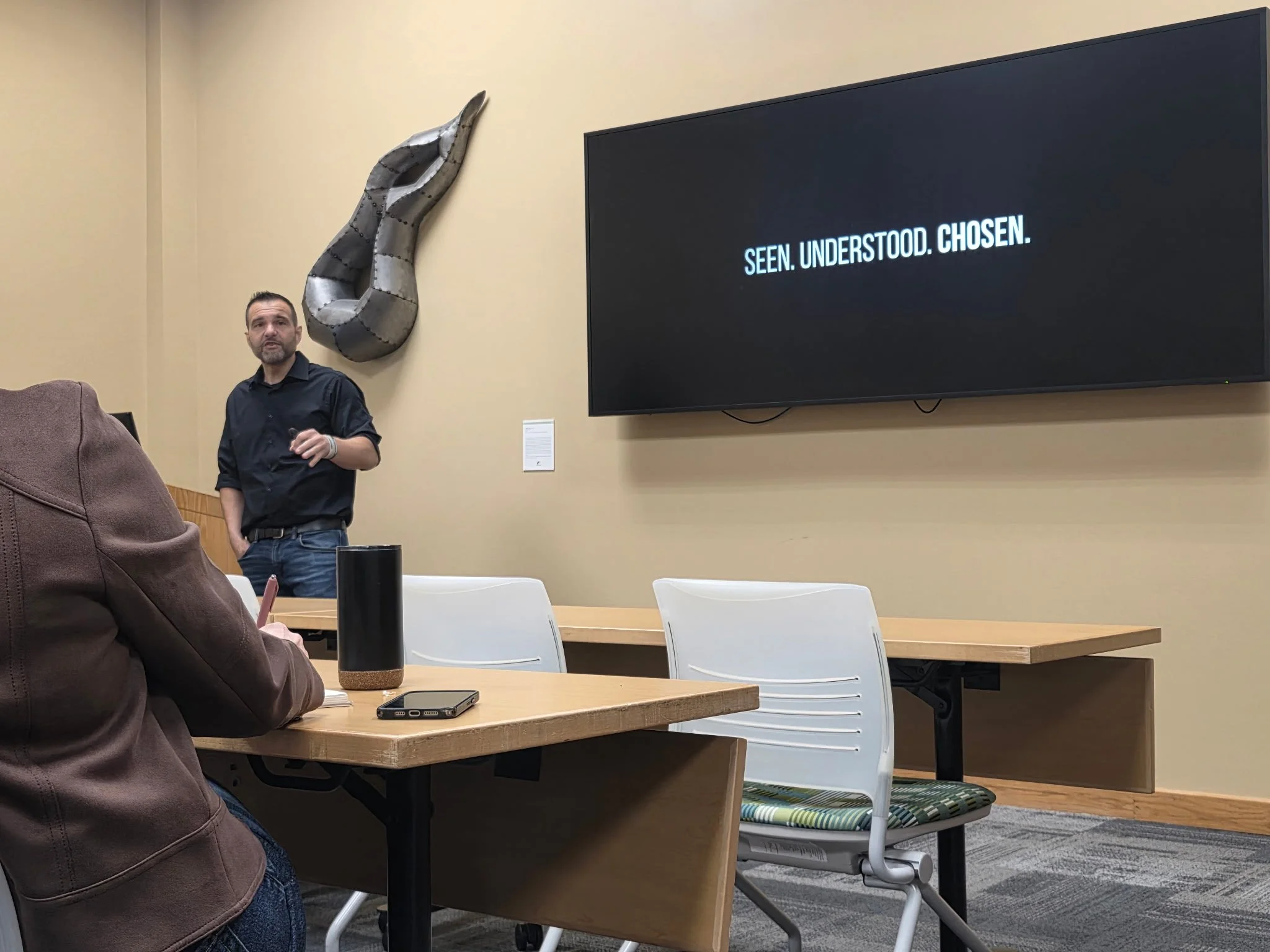
Are you standing in front of a group walking people through the framework? Are participants working together to apply it to their own situations?
Maybe you're sitting across from a client, helping them work through a particular problem.
Does this happen in a boardroom, on a screen, or through individual conversations?
Because showing a graphic of your methodology doesn't necessarily help someone understand what it's like to experience it. And if I'm a potential buyer trying to determine whether you're the right person to help me, that's pretty important information.
This is where the relationship between words, photographs, video, and the rest of your visual presentation becomes so important.
That diagram might do a great job explaining the structure of your methodology.
But what if the same page also included visuals of you teaching it to an audience? Or working directly with participants as they apply what they're learning?
Maybe there's a photograph of a whiteboard covered with ideas from an actual working session. Or a short video showing how you guide people through part of the process.
Now there's more to evaluate than the diagram.
The potential buyer has an opportunity to begin understanding how that framework gets put to work.
And if your work happens primarily over Zoom or the phone, there are still ways to make the experience more tangible through the surrounding language, examples, and evidence of your process.
You don't need to reveal every detail of your methodology or photograph every interaction.
But give people something that helps them visualize what the experience of working with you actually looks like. That's the piece that's often missing.
Give people a reason to keep going.
Experts spend so much time explaining what they know, what they've accomplished, and the methodologies they've created that they sometimes overlook showing people what actually happens when someone hires them.
The visual presentation creates an initial impression. The words, context, and evidence give people something more substantial to evaluate.
And when those elements work together, they can help someone move beyond a general sense that you're impressive and begin understanding whether you're relevant to what they need.
Nobody's obligated to spend five more minutes on your website. They have problems to solve, questions to answer, and other experts they could be evaluating.
So the next time you look at your website, speaker kit, or LinkedIn profile, try seeing it from the perspective of someone who doesn't know anything about you.
Can they get a sense of who you are and what you do?
Can they understand how your expertise relates to the problem they're trying to solve?
And perhaps most importantly, can they begin to picture what it would actually look like to work with you?
Because if those things aren't coming through, you're asking someone to invest more of their time without giving them much reason to do it.
And that's a lot to ask from someone who hasn't even met you yet.